
Choosing a washing machine is an important decision because it is a long-term household purchase. The right model depends on how much laundry you do, the space available in your home, the type of washing machine you prefer, and the features that are actually useful to you.
Washing machines can differ considerably in capacity, washing performance, spin speed, energy and water use, noise levels, and available programs. Understanding these differences can help you choose a machine that fits your household instead of paying for features you may never use.
How Do I Choose the Right Washing Machine?
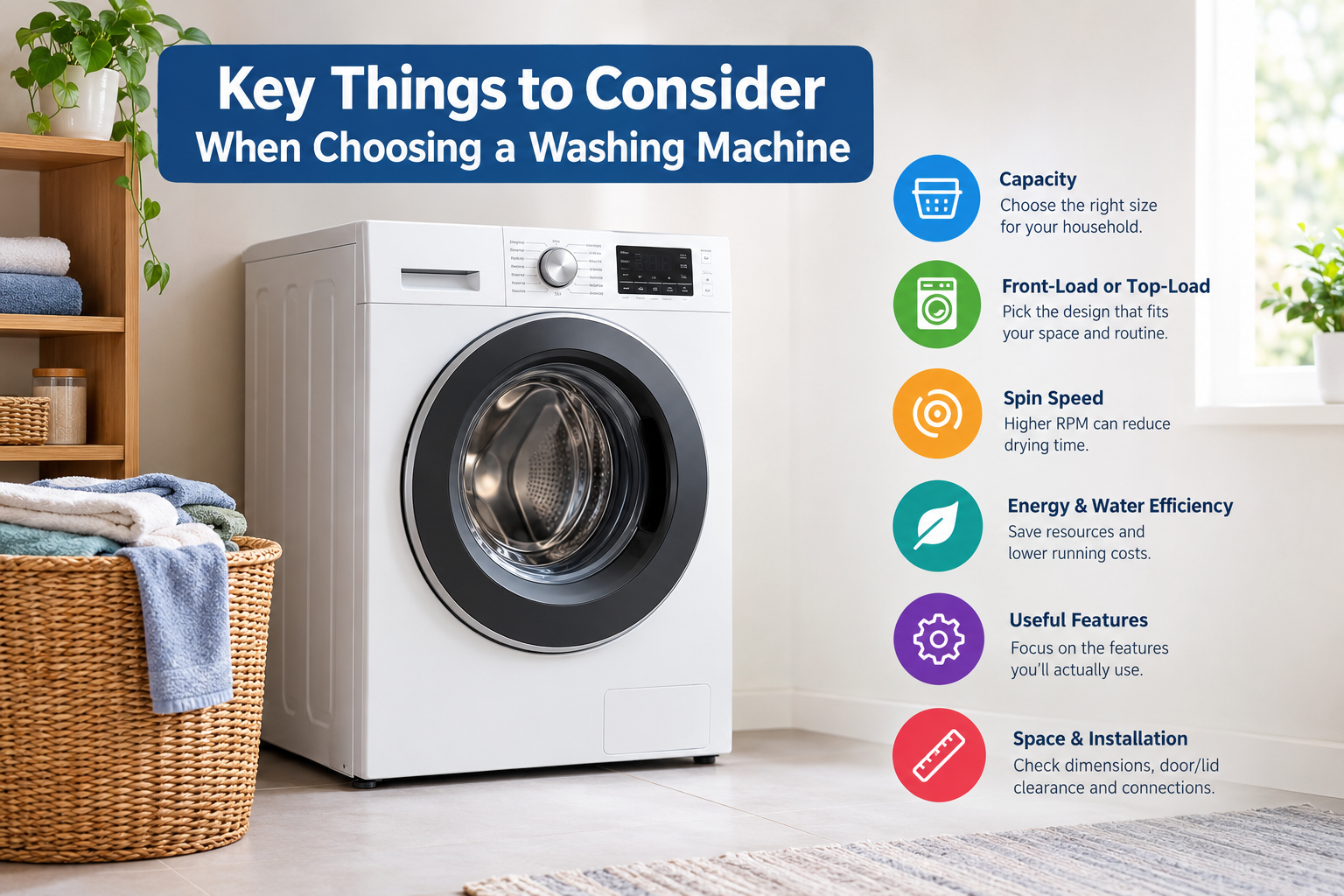
Start by considering your everyday laundry needs rather than choosing a washing machine based only on its appearance or the number of programs it offers.
Think about:
- How many people use the washing machine?
- How often do you wash clothes?
- How much space do you have?
- Do you prefer a front-load or top-load machine?
- Do you regularly wash large or bulky items?
- How important are energy and water savings?
- Which washing programs do you actually need?
A good washing machine should provide enough capacity for your normal laundry without being unnecessarily large for your household.
How Much Washing Machine Capacity Do I Need?
Washing machine capacity is usually measured in kilograms and refers to the maximum weight of dry laundry the machine is designed to handle in a wash cycle.
A smaller household may not need a very large drum, while a larger family may benefit from a higher-capacity machine that can handle more clothes in fewer cycles.
Capacity should also match your laundry habits. If you regularly wash bedding, towels, or other bulky items, having some extra drum space can be useful.
Should I Get a 7kg or 8kg Washing Machine?
The difference between a 7kg and 8kg washing machine may seem small, but the extra capacity can be useful if you regularly have larger loads.
A 7kg machine can be suitable for many smaller households, while an 8kg model may be more convenient for households that wash more clothing or larger items.
Don’t choose the 8kg model simply because it has a higher number. Consider how much laundry you normally wash and whether the additional capacity is worth the extra cost and space.
What Size Washing Machine Is Best for a Family of 5?
A family of five will generally benefit from a washing machine with enough capacity to handle larger loads without requiring frequent cycles.
Around 8kg to 10kg can be a practical range to consider, depending on how often the family does laundry and whether bulky items are washed regularly.
If you do laundry frequently, a smaller machine may still work well. If you prefer fewer, larger loads, a higher-capacity machine can be more convenient.
What Is the Difference Between Front-Load and Top-Load Washing Machines?
The two main washing machine designs are front-load and top-load.
Front-Load Washing Machines
Front-load machines have a door on the front of the appliance. They are often designed to use relatively little water and can provide strong washing performance with different wash programs.
They can also be useful when you want to stack a dryer above the washing machine, provided the models and installation setup support stacking.
One thing to consider is that front-load machines require enough space in front of the door for loading and unloading clothes.
Top-Load Washing Machines
Top-load machines have an opening at the top, which can make loading and unloading convenient.
They can be a practical choice when the available space makes a front-opening door difficult to use. However, the design and water usage can vary considerably between different models.
When comparing top-load machines, check the manufacturer’s specifications rather than assuming every model has the same performance or efficiency.
Is 1200 RPM or 1400 RPM Better?
RPM refers to the maximum spin speed of the washing machine. A higher spin speed can remove more water from clothes during the spin cycle, which may reduce drying time.
A 1200 RPM machine can be sufficient for many households. A 1400 RPM model may be useful if faster water extraction is important to you.
However, higher RPM does not automatically mean better washing performance. The actual results also depend on the washing machine’s design, wash programs, load balance, and fabric settings.
What Washing Machine Features Are Worth Paying For?
Modern washing machines can include many features, but not all of them are equally useful. If you’re also comparing smart appliances for your home, see our guide to Best Smart Kitchen Appliances in 2026.
Consider features that match your normal laundry routine, such as:
- Quick wash programs for lightly soiled clothes
- Adjustable temperature settings
- Different spin-speed options
- Delay-start functions
- Child safety features
- Load-sensing or automatic water adjustment
- Programs for delicate fabrics
- Large-item or bedding programs
Smartphone connectivity can be convenient for some users, but it should not be the main reason to choose a washing machine. Prioritize capacity, washing performance, efficiency, reliability, and the features you will actually use.
How Much Space Do You Need for a Washing Machine?
Measure the space carefully before buying a washing machine. Do not measure only the width of the available area.
Check the:
- Width
- Height
- Depth
- Door or lid clearance
- Space needed for hoses and connections
- Path through doors and hallways for installation
For a front-load machine, make sure there is enough room to open the door fully. For a top-load machine, check that there is sufficient clearance above the appliance to open the lid comfortably.
It is also important to check the manufacturer’s installation requirements before purchasing.
How Important Is Energy Efficiency?
Energy efficiency matters because a washing machine is used repeatedly over many years. A more efficient model may help reduce electricity and water consumption over its lifetime.
When comparing models, look at the official energy and water information provided for your market. You can also check ENERGY STAR’s washing machine buying guidance for information about energy use, water efficiency, capacity, and other factors to consider when choosing a washer.
If you want to compare individual energy-efficient models, you can also use the ENERGY STAR certified clothes washer product finder to compare available models and efficiency information.
What Should You Know Before Buying a Washing Machine?
Before making a purchase, compare the specifications of several models rather than choosing the first machine that looks suitable.
Pay particular attention to capacity, dimensions, wash programs, spin speed, energy and water efficiency, noise levels, warranty coverage, and installation requirements.
Also consider where the machine will be installed and how frequently it will be used. A machine that looks impressive on paper may not be the best choice if it does not fit your space or laundry routine.
How to Choose a Washing Machine That Fits Your Home
The best washing machine is not necessarily the largest or the one with the most features. It is the one that matches your household’s laundry volume, available space, preferred design, and everyday needs.
Focus first on capacity and dimensions, then compare washing performance, spin speed, efficiency, useful programs, and long-term ownership factors. Taking the time to compare these points can help you avoid paying extra for features or capacity you do not need.