
8 Essential Checks to Pick a Robot Vacuum
A robot vacuum can make everyday floor cleaning much easier, and how to choose a robot vacuum helps you select the right model. Today’s models can offer smart mapping, obstacle avoidance, powerful suction, mopping, self-emptying, and app-based controls.
The challenge is knowing which features are genuinely useful for your home and which ones you may never use.
In this guide, we’ll explain the most important things to consider for how to choose a robot vacuum, so you can make a more informed buying decision.
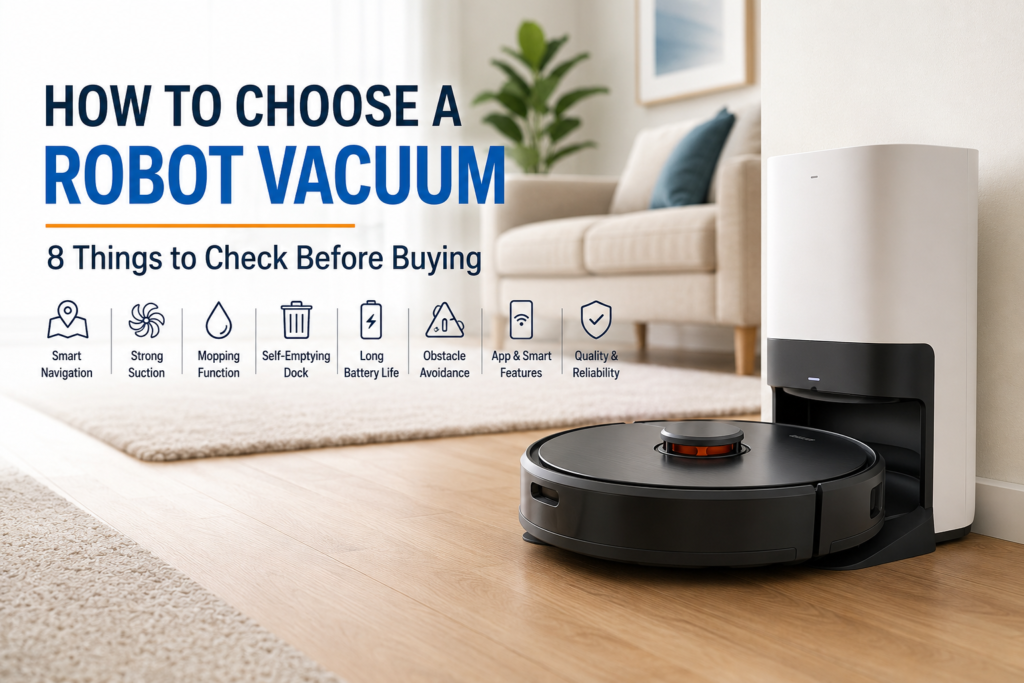
- Consider Your Floor Type
Start by thinking about the floors in your home.
If your home mainly has hardwood, tile, laminate, or other hard flooring, you may want to prioritize good dust pickup, edge cleaning, and mopping performance.
If you have carpets or rugs, look for a robot with an effective brush design and sufficient suction for your flooring. Homes with thick carpets may require different capabilities from homes with mostly hard floors.
If your home has a mixture of hard floors and carpets, consider a model that can automatically adjust its cleaning behavior between different surfaces.
- Check the Navigation System
Navigation is one of the most important features of a robot vacuum.
Basic models may use simple movement patterns, while more advanced robots can create maps of your home and clean rooms in organized paths.
LiDAR Navigation
LiDAR navigation uses laser-based sensing to map the surroundings and can help a robot navigate efficiently. It can be particularly useful in homes with multiple rooms because the robot can create a map and use it for more organized cleaning.
Camera-Based Navigation
Some robot vacuums use cameras and other sensors to understand their surroundings. These systems can help with recognizing objects and navigating around furniture.
Basic Navigation
Entry-level robots may use simpler sensors and movement patterns. These can work in small, uncomplicated spaces, but they may not provide the same mapping and room-management features as more advanced systems.
For many buyers, good navigation is more useful than simply choosing the model with the biggest suction number.
Don’t Choose Based on Suction Power Alone
Suction power is often advertised using Pascal, or Pa, ratings.
A higher number can sound impressive, but suction power should not be the only factor you consider. Actual cleaning performance also depends on the brush system, airflow, floor type, navigation, and how the robot handles debris.
Instead of asking only, “How many Pa does it have?”, consider:
What type of flooring do I have?
- Do I have carpets?
- Do I have pets?
- Does the brush design reduce hair tangling?
- Does the robot clean efficiently?
A balanced combination of suction, brush design, and navigation can be more useful than a large specification number by itself.
- Decide Whether You Need Mopping
Many modern robot vacuums also offer mopping.
This can be useful if your home has mostly hard floors and you want the robot to handle light everyday floor maintenance.
However, not every mopping system works in the same way.
Some models use a simple damp pad, while more advanced systems may use vibrating or rotating mop mechanisms. Some premium systems can also wash and dry the mop automatically at the docking station.
If you have carpets and hard floors, pay particular attention to how the robot handles its mop when it encounters carpet.
Remember that a robot vacuum-mop is not necessarily a replacement for occasional deep cleaning.
- Consider a Self-Emptying Base
A self-emptying dock can make a robot vacuum much more convenient.
Instead of manually emptying the robot’s dustbin after every cleaning session, the docking station can transfer collected debris into a larger container or bag.
This is especially useful if:
- You have pets
- Your home gets dusty quickly
- You run the robot frequently
- You want less daily maintenance
Some advanced docking stations go beyond self-emptying and can also wash or dry mop pads and manage water.
These features can increase convenience, but they can also increase the purchase price and the amount of space required.
- Check Battery Life and Recharge Features
Battery life becomes more important as your home gets larger.
A robot with a longer runtime may be able to clean more of your home in one session. However, battery capacity is not the only thing that matters.
Look for features such as automatic recharge and resume. With this feature, the robot can return to its dock when its battery is low, recharge, and continue cleaning afterward.
Also consider whether the robot can save multiple floor maps if you have more than one level in your home.
- Look at Obstacle Avoidance
Homes contain many objects that can cause problems for robot vacuums.
Cables, shoes, toys, furniture, curtains, and other small objects can interfere with cleaning.
More advanced obstacle-detection systems can help the robot identify and avoid objects rather than simply bumping into them.
However, no robot should be expected to handle a completely cluttered floor perfectly.
Before running the robot, it is still a good idea to remove loose cables, small objects, and anything that could become trapped in the brush.
- Check the App and Smart Features
Many robot vacuums connect to a smartphone app.
Depending on the model, the app may allow you to:
- Create cleaning schedules
- Select individual rooms
- Create no-go zones
- Adjust cleaning settings
- Monitor cleaning progress
- View maps
- Start or stop cleaning remotely
Smart-home compatibility may also be useful if you already use a compatible voice assistant or smart-home system.
But don’t pay extra for smart features you won’t actually use. The basic cleaning performance should remain your priority.
How to choose a robot vacuum: Robot Vacuum Features Worth Comparing
Before buying, compare these important features:
Navigation: Helps the robot clean efficiently.
Suction and brush system: Affects how well it picks up dust, debris, and hair.
Mopping: Useful for maintaining hard floors.
Self-emptying: Reduces how often you need to empty the dustbin.
Obstacle avoidance: Helps prevent collisions and getting stuck.
Battery life: Particularly important for larger homes.
Recharge and resume: Allows the robot to continue cleaning after recharging.
App controls: Makes scheduling and room selection easier.
Multi-floor mapping: Useful if your home has multiple levels.
Warranty and support: Important for long-term ownership.
Which Features Matter Most for Different Homes?
The best robot vacuum depends on your home.
For Small Apartments
Focus on:
- Compact design
- Reliable navigation
- Good battery management
- Easy maintenance
You may not need a large docking station with every advanced feature.
For Large Homes
Consider:
- Efficient mapping
- Longer battery life
- Recharge and resume
- Multi-floor mapping
- Larger dust capacity or self-emptying
These features can reduce the amount of manual attention required.
For Homes With Pets
Pet owners may want to prioritize:
- Effective hair pickup
- Brush systems designed to reduce tangling
- Strong navigation
- Self-emptying
- Easy filter and brush maintenance
A robot vacuum can help with everyday pet hair, but regular manual cleaning may still be necessary.
For Homes With Mostly Hard Floors
Consider:
- Good dust pickup
- Edge cleaning
- Effective mopping
- Carpet detection if rugs are present
- Mop-lifting or carpet-management features
Common Mistakes to Avoid
Buying Only Because of a High Suction Number
A large Pa rating does not automatically mean better cleaning everywhere.
Ignoring Your Floor Type
A robot that works well on hard floors may not be the best choice for thick carpet.
Buying More Features Than You Need
Self-emptying, mop washing, advanced cameras, and other features can be useful, but they also add cost.
Forgetting About Dock Size
A robot vacuum may be small, but its docking station can take considerably more space.
Measure the area where you plan to place the dock before buying.
Not Checking Replacement Costs
Filters, brushes, mop pads, dust bags, and other consumables may need replacement.
Check availability and cost before choosing a model.
Is a Robot Vacuum Worth Buying?
For many households, a robot vacuum can be a useful convenience appliance.
Its biggest advantage is not necessarily that it completely replaces a traditional vacuum cleaner. Instead, it can help maintain floors through regular automated cleaning.
Running a robot on a schedule can reduce the amount of everyday dust, crumbs, and hair that accumulate between deeper cleaning sessions.
Whether it is worth the money depends on your home, cleaning habits, floor type, and how much you value automation.
Final Thoughts
The best robot vacuum is not necessarily the model with the highest suction rating or the most expensive docking station.
A better approach is to match the robot to your home.
Consider your floor type, navigation requirements, cleaning needs, pet situation, battery requirements, mopping preferences, and desired level of automation.
Take the time to compare the features that actually matter to you. A well-chosen robot vacuum can become a useful part of your regular cleaning routine and save you time on everyday floor maintenance.
Before buying, always check the manufacturer’s current specifications, warranty, replacement parts, and retailer information because features and availability can change.