
Buying a microwave oven can look simple until you start comparing different sizes, power levels, types, and features. A microwave that works well for one household may be unnecessarily large or expensive for another.
The right choice depends on what you cook, how much food you usually prepare, how much space you have, and which features you will actually use.
Before buying one, it is worth understanding the differences between microwave types, capacity, cooking power, useful features, and other practical considerations.
How to Choose a Microwave Oven
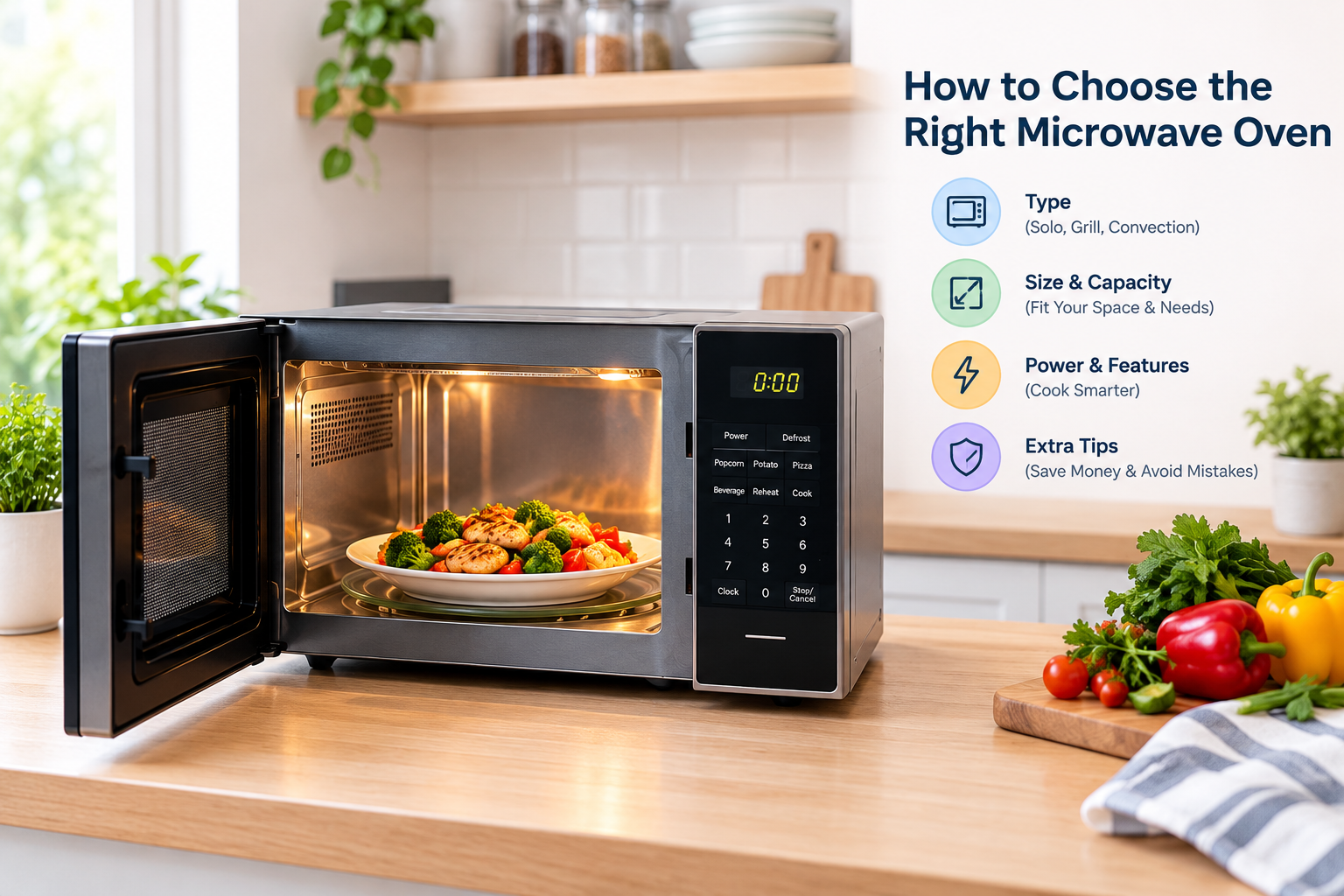
Start by thinking about how you will actually use the microwave.
If you mainly want to reheat leftovers, warm drinks, or defrost food, you may not need a large model with advanced cooking functions.
If you regularly cook larger portions or want to use the microwave for more than reheating, capacity, power, and cooking functions become more important.
Ask yourself:
- How often will I use it?
- What types of food will I prepare?
- How much food do I normally heat at once?
- Where will I put it?
- Do I need simple controls or additional cooking functions?
Answering these questions first can prevent you from paying for features you do not need.
If you’re comparing different kitchen appliances before making a purchase, see our guide to the best smart kitchen appliances in 2026.
What Type of Microwave Oven Should You Buy?
Microwave ovens are available in several types, and each is designed for somewhat different needs.
Solo Microwave
A solo microwave is generally designed for basic microwave cooking, reheating, and defrosting.
It can be a practical choice if you mainly want a straightforward appliance for everyday tasks.
Grill Microwave
A grill microwave adds a grilling function to the microwave.
This can be useful if you want to brown or grill certain foods in addition to reheating and cooking.
Convection Microwave
A convection microwave combines microwave cooking with convection heating.
This can make it more versatile for people who want to prepare a wider range of foods without buying a separate oven for every cooking task.
However, additional functions can also increase the price, so consider whether you will actually use them.
What Size Microwave Oven Should You Buy?
The physical size of the microwave matters just as much as its internal capacity.
Before buying, measure the space where you plan to put it.
Check:
- Available width
- Available height
- Available depth
- Door-opening space
- Ventilation requirements
Do not measure only the microwave itself. Make sure there is enough room around it according to the manufacturer’s installation instructions.
A microwave that fits the countertop but leaves insufficient clearance may be a poor choice.
How Much Microwave Capacity Do You Need?
Microwave capacity is commonly expressed in litres or cubic feet, depending on the market.
The right capacity depends on your household and the size of the dishes you normally use.
A smaller microwave may be sufficient for:
- One person
- Small portions
- Drinks
- Reheating leftovers
A larger microwave may make more sense for:
- Families
- Larger plates
- Bigger portions
- Frequent cooking
Do not automatically choose the largest capacity available. A larger model can take considerably more counter space.
Choose a capacity that comfortably accommodates the dishes and portions you actually use.
What Microwave Wattage Is Best?
Microwave power is usually measured in watts (W).
Higher wattage generally means the microwave can deliver more cooking power, but the highest wattage is not automatically the best choice for everyone.
For everyday reheating and cooking, a moderate-power microwave may be perfectly adequate.
When comparing models, look at the manufacturer’s stated cooking power, rather than assuming that a higher number automatically means better overall performance.
Also remember that cooking times in recipes can vary depending on the microwave’s power. If you move from a lower-powered model to a more powerful one, you may need to adjust cooking times.
What Microwave Features Should You Look For?
Microwaves can include many different features, but not all of them are equally useful.
Some features worth considering include:
- Defrost settings
- Preset cooking programs
- Timer
- Adjustable power levels
- Child safety lock
- Quick-start controls
- Sensor cooking
- Grill function
- Convection cooking
Which Features Are Actually Worth Paying For?
Think about your normal routine.
If you mainly reheat food, a simple microwave with easy controls may be more useful than a model packed with cooking programs.
If you cook frequently, sensor cooking, multiple power levels, or additional cooking modes may be more valuable.
The goal is not to buy the microwave with the longest feature list. It is to buy the features you will actually use.
How Much Power Does a Microwave Use?
Microwaves use electricity while operating, and their power rating can give you an idea of the electrical power they draw during operation.
However, the amount of electricity used depends on factors such as:
- Cooking time
- Power level
- How frequently you use the microwave
- The appliance’s efficiency
For occasional reheating, the total electricity used may be relatively modest because the microwave is operating for only a short period.
If energy use is important to you, compare the manufacturer’s specifications and consider how long and how often you expect to use the appliance.
What Should You Check Before Buying a Microwave Oven?
Counter Space
Make sure the microwave physically fits where you want to place it.
Interior Space
Check whether your usual plates, bowls, or containers will fit comfortably.
Controls
Choose controls that are easy for everyone in your household to understand and use.
Cleaning
Look for an interior that is reasonably easy to wipe clean. A complicated interior can make regular cleaning more frustrating.
For safe microwave use, it is also important to follow the manufacturer’s instructions and use microwave-safe containers.
Noise
If possible, check reviews for comments about operating noise, especially if the microwave will be used in a small or quiet kitchen.
Warranty and Support
Check the manufacturer’s warranty and whether replacement parts or customer support are available in your region.
Common Microwave Buying Mistakes to Avoid
Buying the Biggest Microwave
More capacity is not automatically better if you rarely cook large portions.
Choosing Only by Wattage
Power is important, but it should not be the only factor you consider.
Paying for Features You Will Not Use
A feature-rich microwave is not good value if you only use it to reheat food.
Forgetting to Measure Your Space
Always measure the available space before ordering.
Ignoring Your Dish Size
A microwave may have a reasonable overall capacity but still not accommodate the plates or containers you normally use.
Choosing Based Only on Appearance
A stylish microwave may look great in your kitchen, but practical factors such as capacity, controls, power, cleaning, and reliability matter more.
How to Choose a Good Microwave Oven
A good microwave oven should match your cooking habits, available space, household size, and budget.
For basic reheating and defrosting, you may be better off with a simple model. If you want more versatility, a grill or convection model may be worth considering.
Before buying, compare the microwave’s type, physical dimensions, capacity, cooking power, useful features, energy use, controls, cleaning requirements, and warranty.
Most importantly, do not buy based on the biggest number or longest feature list. Choose the microwave that solves your everyday cooking needs without making you pay for things you do not need.