
Choosing a dishwasher isn’t as simple as picking the cheapest one on the shelf. Capacity, noise levels, energy efficiency, and cleaning technology all vary widely between models — and the wrong choice can mean dishes that come out spotted, cycles that take three hours, or a machine that hums loud enough to hear from the next room. This guide breaks down exactly what to look for so you can pick a dishwasher that actually fits your kitchen and your habits.
How Do You Know When It’s Time for a New Dishwasher?
Before shopping, it helps to know when an upgrade is worth it. A few signs your current dishwasher (or hand-washing routine) isn’t cutting it anymore:
- Dishes regularly come out with spots, residue, or food particles still stuck on
- Cycles take longer than 2–3 hours for a normal wash
- The unit is noticeably loud, making it hard to run during the day
- Your water and energy bills seem high relative to your usage
- You’re renovating or moving into a space without one installed
If any of these sound familiar, it’s worth comparing current models rather than tolerating an aging or inefficient machine.
If you’re also comparing other major kitchen appliances, see our guide to the best kitchen home appliances in 2026.
What Types of Dishwashers Are Available?
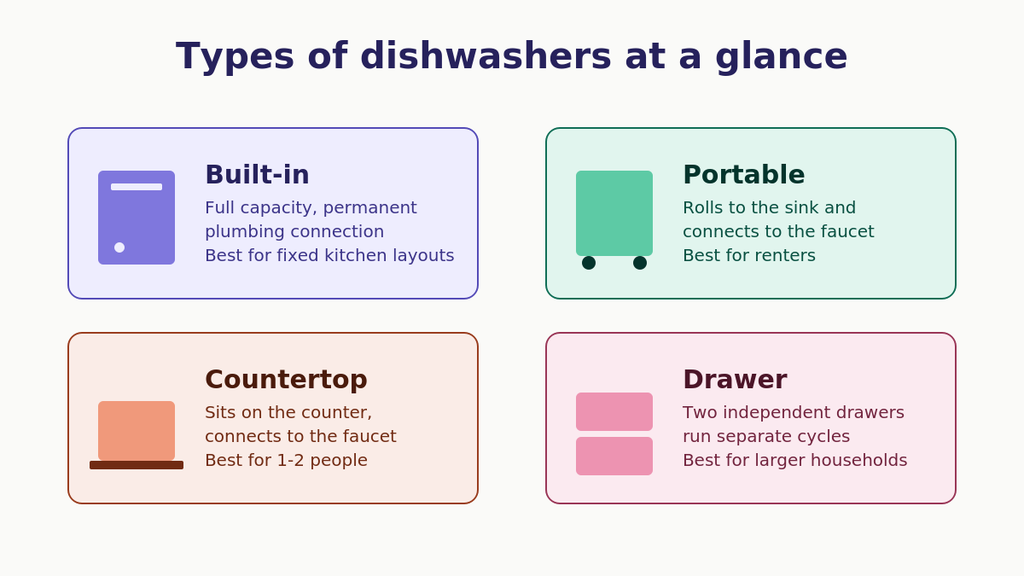
Built-In (Under-Counter) Dishwashers
The most common type, installed directly under your kitchen counter. These offer the most capacity and permanent plumbing connections, making them ideal for anyone with a fixed kitchen layout.
Check out the Summit Appliance 24″ Stainless Steel Built-In Dishwasher for a solid example of a full-size under-counter model.
Portable Dishwashers
These stand on wheels and connect temporarily to your kitchen faucet. A good option for renters or smaller kitchens where a built-in unit isn’t practical.
Check out this portable dishwasher with faucet connection if a built-in unit isn’t an option.
Countertop Dishwashers
Compact units that sit on your counter and connect to the faucet, designed for singles, couples, or very small kitchens with limited space and lower dish volume.
Take a look at this compact countertop dishwasher for small kitchens.
Drawer Dishwashers
Two independent drawers that can run separate cycles at the same time — useful for larger households that want flexibility without running a full-size load for a few items.
See this dual-drawer dishwasher for flexible, split-load washing.
What Features Actually Matter When Choosing a Dishwasher?
1. How Much Capacity Do You Need?
Dishwashers are usually rated by how many “place settings” they hold — typically ranging from 6 (compact) to 16+ (large family size). A household of 1–2 people is usually fine with 8–10 settings, while families of 4 or more should look at 12–14+.
2. How Loud Is Too Loud?
This is one of the most overlooked specs. Ratings under 45 dB are considered whisper-quiet and safe to run overnight or during conversations. Anything above 50 dB will be noticeably audible in an open kitchen or living space.
| Noise Rating | Experience |
|---|---|
| Under 40 dB | Virtually silent, can’t hear it from adjacent rooms |
| 40–45 dB | Quiet hum, unnoticeable during normal activity |
| 46–50 dB | Audible but not disruptive |
| Above 50 dB | Noticeably loud, best run when away or asleep |
3. How Energy Efficient Is the Model?
Look for an Energy Star certification (or your region’s equivalent). Efficient models use significantly less water per cycle than older units — often under 3 gallons compared to 6+ gallons in older machines — which adds up on both your water and electricity bills over time.
This Energy Star certified dishwasher is a good example of a water- and energy-efficient model.
4. What Wash Cycles and Sensors Should You Look For?
Most modern dishwashers include:
- Normal/Eco cycle for everyday loads
- Heavy/Pots & Pans cycle for baked-on food
- Quick wash for lightly soiled dishes
- Sensor wash that automatically detects soil level and adjusts water/time
Soil-sensing technology is worth prioritizing if you want a “set it and forget it” experience rather than manually picking a cycle every time.
5. How Important Is Rack Design and Flexibility?
Adjustable upper racks, fold-down tines, and dedicated silverware trays or baskets make a bigger day-to-day difference than most buyers expect. If you regularly wash larger pots, bowls, or oddly shaped items, prioritize a model with foldable or removable rack sections.
Look for a model like this dishwasher with fully adjustable racks for maximum loading flexibility.
6. How Well Does It Dry Dishes?
Two common drying methods:
- Heated drying — uses a heating element, faster but slightly higher energy use
- Condensation drying — uses a stainless steel tub to naturally evaporate moisture, more energy efficient but slower
If plastics coming out damp is a dealbreaker for you, look specifically for models with heated dry or a “steam/fan-assisted” drying option.
How Much Should You Spend on a Dishwasher?
Entry-Level (Budget-Friendly)
Covers the basics — decent cleaning, standard cycles, average noise levels around 50 dB. A solid choice if you just need reliable daily washing without extra features.
A good example in this tier is this budget-friendly dishwasher.
Mid-Range
Usually adds quieter operation (44–48 dB), soil sensors, and better rack flexibility. This tier offers the best balance of price and features for most households.
Our pick here is this well-rated mid-range dishwasher.
What Should You Check Before Installing a Dishwasher?
- Standard vs. compact size: Most built-in units are 24 inches wide; compact models are typically 18 inches — measure your cabinet space before buying.
- Existing plumbing: Confirm your kitchen already has the water line and drain hookup needed, or budget for installation if it doesn’t.
- Portable/countertop models: Check faucet compatibility, since not all faucet adapters fit every sink.
How Do You Make a Dishwasher Last Longer?
- Clean the filter every 2–4 weeks to prevent clogs and odors
- Run a monthly cleaning cycle with a dishwasher-safe cleaner to remove mineral buildup
- Check and clear the spray arms if you notice weaker cleaning performance
- Use rinse aid to prevent spotting, especially in hard water areas
- Avoid overloading — it reduces water circulation and cleaning effectiveness
Pair your dishwasher with dishwasher cleaning tablets to keep it running at its best.
So, How Do You Choose the Right Dishwasher for You?
For most households, a mid-range built-in dishwasher with a soil sensor, adjustable racks, and a noise rating under 48 dB hits the sweet spot between price and performance. Smaller households or renters are better served by a compact or portable model, while larger families with heavier daily loads should prioritize higher capacity and a third utensil rack.
Whatever your kitchen size or budget, matching the dishwasher to your actual usage — not just the lowest price tag — is what determines whether you’re happy with it a year from now.
Disclosure: As an Amazon Associate, we earn from qualifying purchases made through links on this page.