
A blender can look like a simple kitchen appliance until you start comparing models. One has a powerful motor, another comes with several speed settings, and another promises to crush ice, make smoothies, prepare sauces, and do almost everything else.
This blender buying guide is designed to help you choose a blender based on how you actually plan to use it, rather than simply choosing the most powerful or expensive model.
But here’s the problem: the blender with the biggest motor or longest feature list isn’t necessarily the right one for your kitchen.
What matters is how the blender fits your actual routine. If you mainly make a morning smoothie, you have different requirements from someone who prepares soup, frozen drinks, sauces, or large batches for the family.
Before spending your money, these are the things I would check first.
1. Start With What You Actually Make
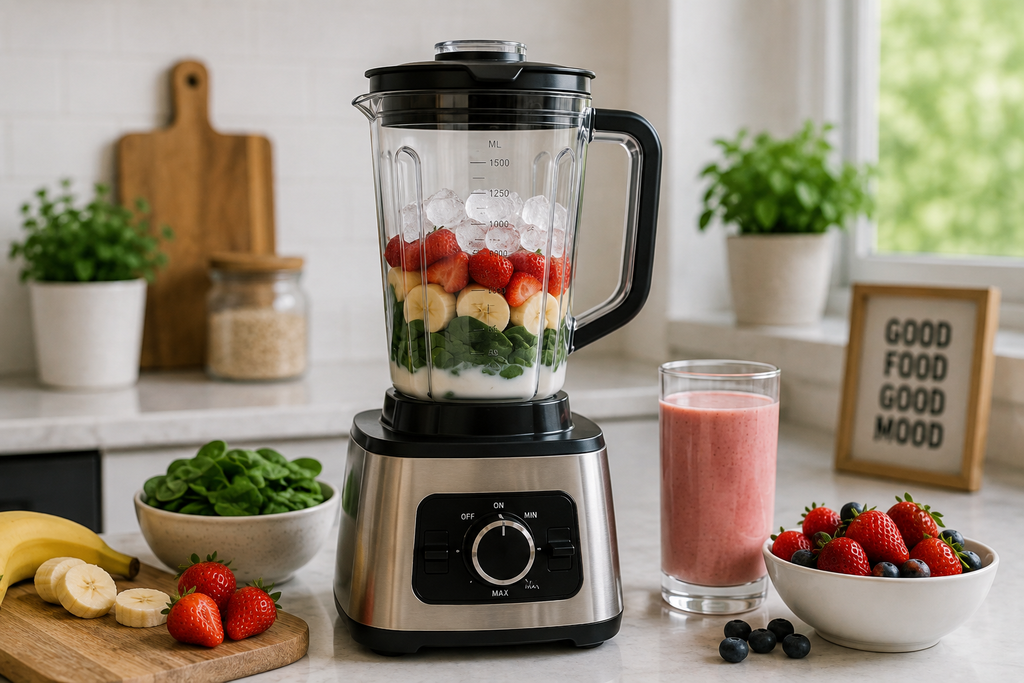
The easiest mistake is choosing a blender before deciding what you want it to do.
Think about your usual kitchen routine. Do you want quick smoothies before work? Do you regularly blend frozen fruit? Are you preparing sauces or soups? Do you need several servings at once?
These questions matter because a small personal blender can be convenient for individual drinks but less practical when you are preparing a large batch. Similarly, a powerful full-size blender may be unnecessary if you only make occasional soft-fruit smoothies.
Write down the three things you expect to make most often. That short list is more useful than starting with a manufacturer’s specification sheet.
2. Don’t Let the Wattage Number Make the Decision
Motor power matters, particularly when you expect the blender to deal with demanding ingredients. But wattage alone doesn’t tell you how well a particular blender will perform.
The motor works together with the blades, container design, controls, and the manufacturer’s overall design. A larger number on the box doesn’t automatically guarantee a better result.
If you regularly use frozen fruit, ice, fibrous vegetables, or thick mixtures, look at what the manufacturer specifically says the blender is designed to handle. KitchenAid, for example, recommends higher-powered models for demanding tasks such as green smoothies with fibrous vegetables and frozen drinks.
For ordinary soft ingredients, paying a large premium purely for maximum power may not make much sense.
3. Get the Jar Size Right
Jar capacity is one of those specifications that sounds simple but becomes very important once you start using the appliance.
A small container is convenient for one person and usually takes up less space. A larger container becomes much more useful when you’re preparing several servings at once.
Don’t look only at the number of litres or cups, though. Check the blender’s physical dimensions as well.
A large blender may fit comfortably on a showroom shelf but become annoying in a small kitchen when you have to find somewhere to store the jar and lid.
As a rough practical guide:
- Single servings: consider a personal or compact blender.
- Two or three servings: a medium-sized container may provide a good balance.
- Family batches: a larger full-size jar is usually more convenient.
Also check the manufacturer’s stated capacity and maximum fill line. The usable amount is not necessarily the same as the container’s total capacity.
4. Pay Attention to the Jar Material
The container affects more than appearance. Weight, durability, heat tolerance, and ease of handling can all differ depending on the material.
Glass can feel substantial and is easy to inspect, but it is heavier and can break if dropped. Plastic containers are generally lighter and easier to handle, but the exact material and care instructions vary between models.
If you expect to prepare hot foods, don’t assume that every blender container is suitable for them. Check the manufacturer’s instructions before putting hot ingredients into the jar.
This is especially important because heat, steam, and pressure can change how a container and lid need to be designed.
5. Look Beyond the Number of Blades
It’s tempting to compare blenders by counting blades, but that number doesn’t tell the whole story.
The blade assembly works together with the shape of the container. The way ingredients circulate inside the jar can affect how evenly they reach the blades.
So rather than asking, “Does this blender have six blades?”, ask a more useful question:
“Is this blender designed to handle the ingredients I normally use?”
If you’re comparing two models, independent reviews can be particularly useful here because they may reveal whether a blender leaves chunks, struggles with thick mixtures, or requires frequent stopping and stirring.
6. More Speed Settings Aren’t Always Better
A blender with ten or more speed settings may look more advanced than one with three or four, but most people don’t need to use every setting.
What matters is whether the controls give you enough control over the textures you actually prepare.
A pulse function can be useful when you want short bursts of blending. Variable speed can also be helpful when you want to start gently and gradually increase the speed.
Pre-programmed settings can be convenient too, especially if you frequently prepare the same types of recipes.
But if you normally press one button and let the blender do its job, paying extra for a complicated control system may not improve your experience.
7. Think About Noise Before Bringing It Into Your Kitchen
This is one feature that’s easy to overlook when shopping online.
A blender can be perfectly good at its main job and still be annoying if it is extremely loud every time you use it.
Think about when and where you’ll use it. If you live in an apartment, share your home with other people, or regularly make breakfast early in the morning, noise may matter more to you than an extra speed setting.
Unfortunately, product pages don’t always give you enough information to judge real-world noise. This is an area where independent reviews and demonstrations can be more useful than a specification list.
8. Cleaning Is Part of the Blender Experience
Imagine using your new blender every morning. The smoothie takes one minute to make, but cleaning the appliance takes five minutes because food gets trapped around difficult-to-reach areas.
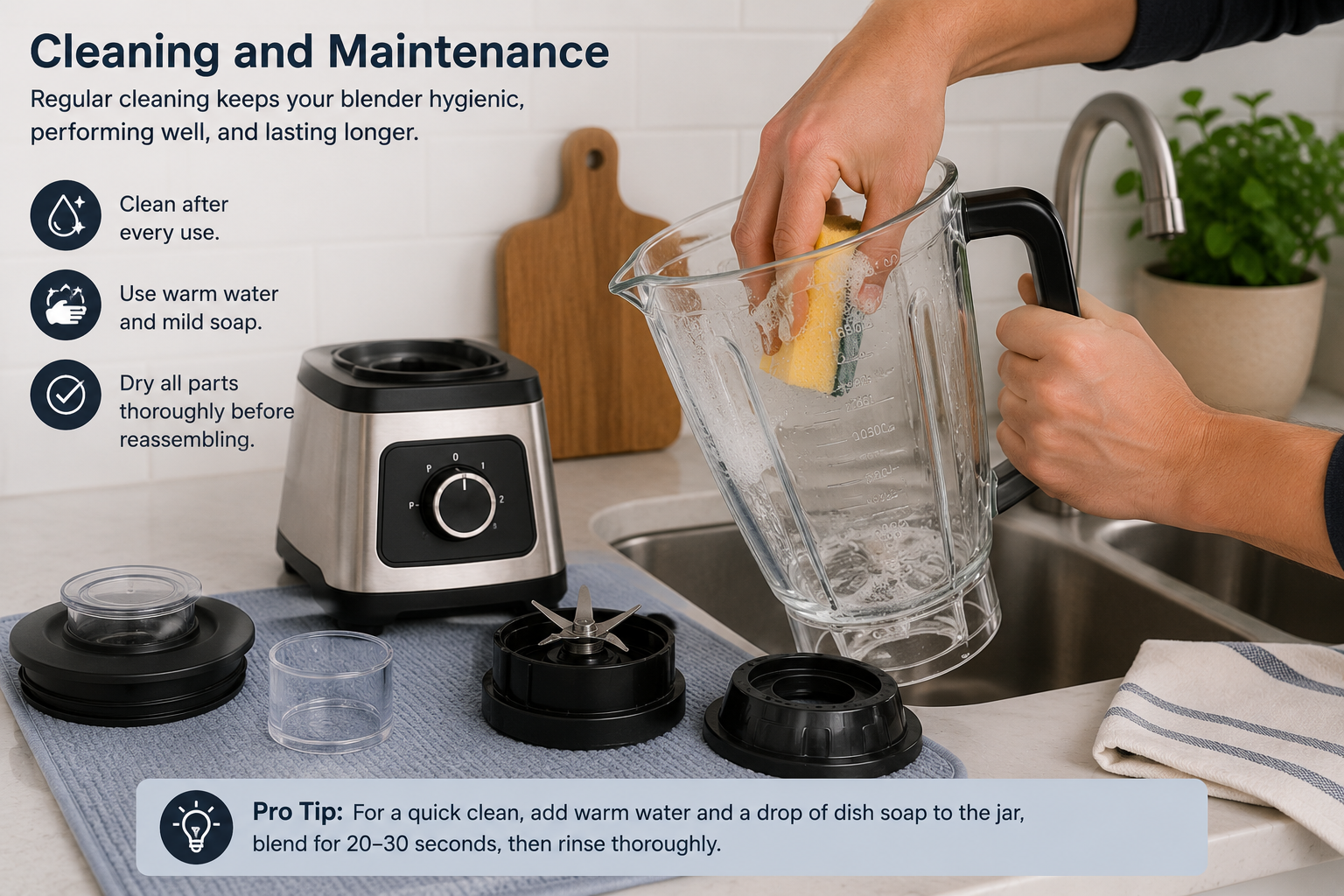
That small inconvenience can become a reason to stop using the blender regularly.
Before buying, check:
- Whether the container is dishwasher-safe
- How easily the lid comes apart for cleaning
- Whether food can become trapped around the blade area
- How the manufacturer recommends cleaning the container
- Whether the motor base can simply be wiped clean
Cleaning instructions vary significantly between models, so don’t assume that a dishwasher-safe label applies to every part. For example, Blendtec gives separate cleaning instructions for its jar, lid, and motor base and warns against immersing the motor base in water.
9. Check the Warranty and Replacement Support
A blender is not something you want to replace every few months.
When comparing models at similar prices, take a minute to look at the warranty and manufacturer’s support. Check how long the warranty lasts and whether replacement components are available.
Parts such as lids, containers, seals, and other accessories can be more useful to replace than the entire appliance if something wears out or gets damaged.
This is particularly worth considering if you expect to use your blender several times a week.
10. Don’t Pay for Features You’ll Never Use
This is where many blender purchases go wrong.
A premium model may offer more power, more programs, extra accessories, advanced controls, and a larger container. Those features can be valuable—but only when they solve problems you actually have.
If you make a simple smoothie a few times a week, you probably don’t need a professional-style machine designed for demanding workloads.
On the other hand, if you regularly blend frozen ingredients, thick mixtures, or large batches, spending more on a suitable model can make sense.
The goal isn’t to find the blender with the most features. It’s to find the blender where the important features match your routine.
Which Blender Type Makes Sense for You?
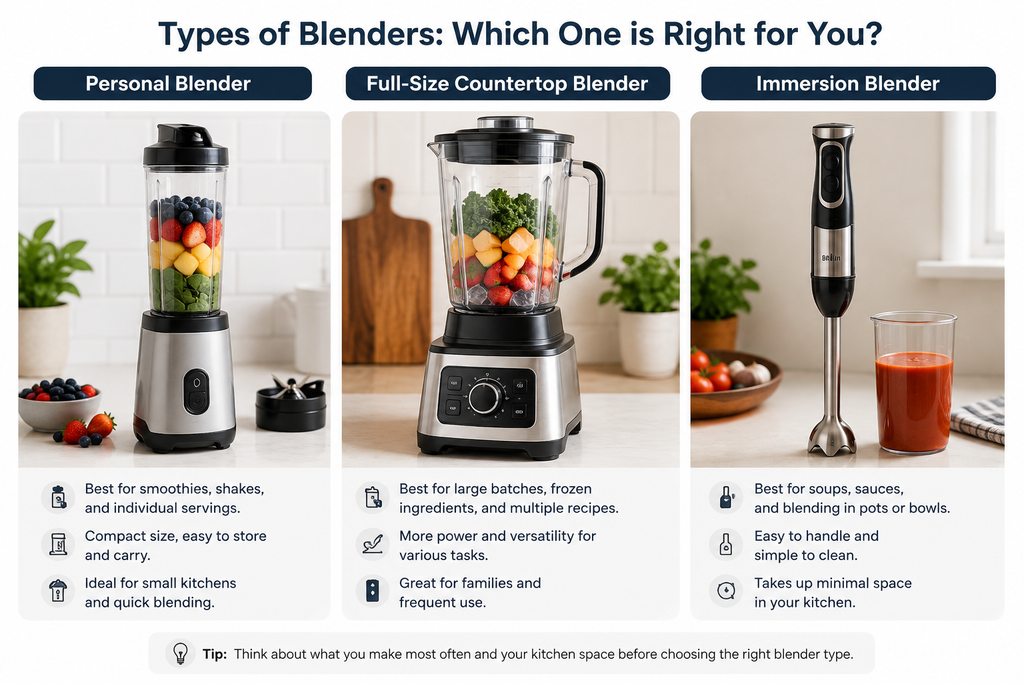
Personal Blender
A personal blender can be convenient if you’re mainly making individual smoothies or drinks. Its smaller footprint can also be useful in a kitchen where counter space is limited.
Full-Size Countertop Blender
This is the more flexible choice if you prepare larger quantities or want one appliance for several different types of blending tasks.
Immersion Blender
If your main goal is blending soups or sauces directly in a pot or container, an immersion blender can sometimes be more practical than a traditional countertop model.
The important point is to choose between different types of blenders before getting distracted by individual models.
What I Would Check Before Paying
When you have narrowed your choices down to two or three blenders, don’t immediately choose the one with the highest rating or biggest discount.
Instead, compare them side by side.
- What ingredients can each model handle?
- Which one has the right container size?
- Which one fits your available counter and storage space?
- Which one is easier to clean?
- Which one has the controls you will actually use?
- Which one has the better warranty and support?
- Are you paying extra for features you don’t need?
This final comparison often tells you more than the headline specifications.
Common Blender Buying Mistakes
Choosing the Highest Wattage
A powerful motor can be useful, but maximum power isn’t automatically the best value for every kitchen.
Buying the Biggest Jar
A large container is useful for family batches, but unnecessary size can make storage and everyday handling harder.
Ignoring Cleaning
If the blender is difficult to clean, you may use it less often than you expected.
Focusing on Features Instead of Use
A long feature list looks impressive, but the features that matter are the ones that solve your everyday problems.
Ignoring the Manufacturer’s Instructions
Always check the instructions for maximum capacity, ingredient temperature, cleaning, operating time, and other limitations. These details can vary between models.
A Quick Checklist Before You Buy
- Know what you will blend most often.
- Choose a suitable blender type.
- Check motor specifications without relying on wattage alone.
- Choose a practical container size.
- Check the container material and temperature limitations.
- Look beyond the number of blades.
- Make sure the controls suit your cooking habits.
- Consider how much noise you can tolerate.
- Check cleaning instructions carefully.
- Look at warranty and replacement support.
- Don’t pay extra for features you won’t use.
Final Thoughts
The best blender isn’t necessarily the most powerful one or the most expensive one on the shelf.
A good purchase starts with a much simpler question: What do I actually need this appliance to do?
Once you know the answer, the specifications become easier to understand. You can decide whether you need a personal blender or full-size model, how much capacity is practical, whether extra power is worthwhile, and which features will genuinely make your kitchen routine easier.
Take a little time to compare those factors before buying. A blender that matches your everyday needs is far more useful than one that simply looks impressive on a product page.
If you’re also comparing other kitchen appliances, see our Best Kitchen Appliances guide for more useful options.
Pingback: How a Coffee Maker Works: A Simple Step-by-Step Guide