
Buying a mobile charger may seem simple, but choosing the wrong one can mean slower charging, poor compatibility, unnecessary expense, or even safety concerns. With different charging speeds, ports, cables, and technologies available, it is important to understand what your device actually needs.
A higher-watt charger is not always better, and the cheapest charger is not always a good deal. The right choice depends on your phone, its charging technology, and the quality of the charger.
Here are 8 important things to check before buying a mobile charger.
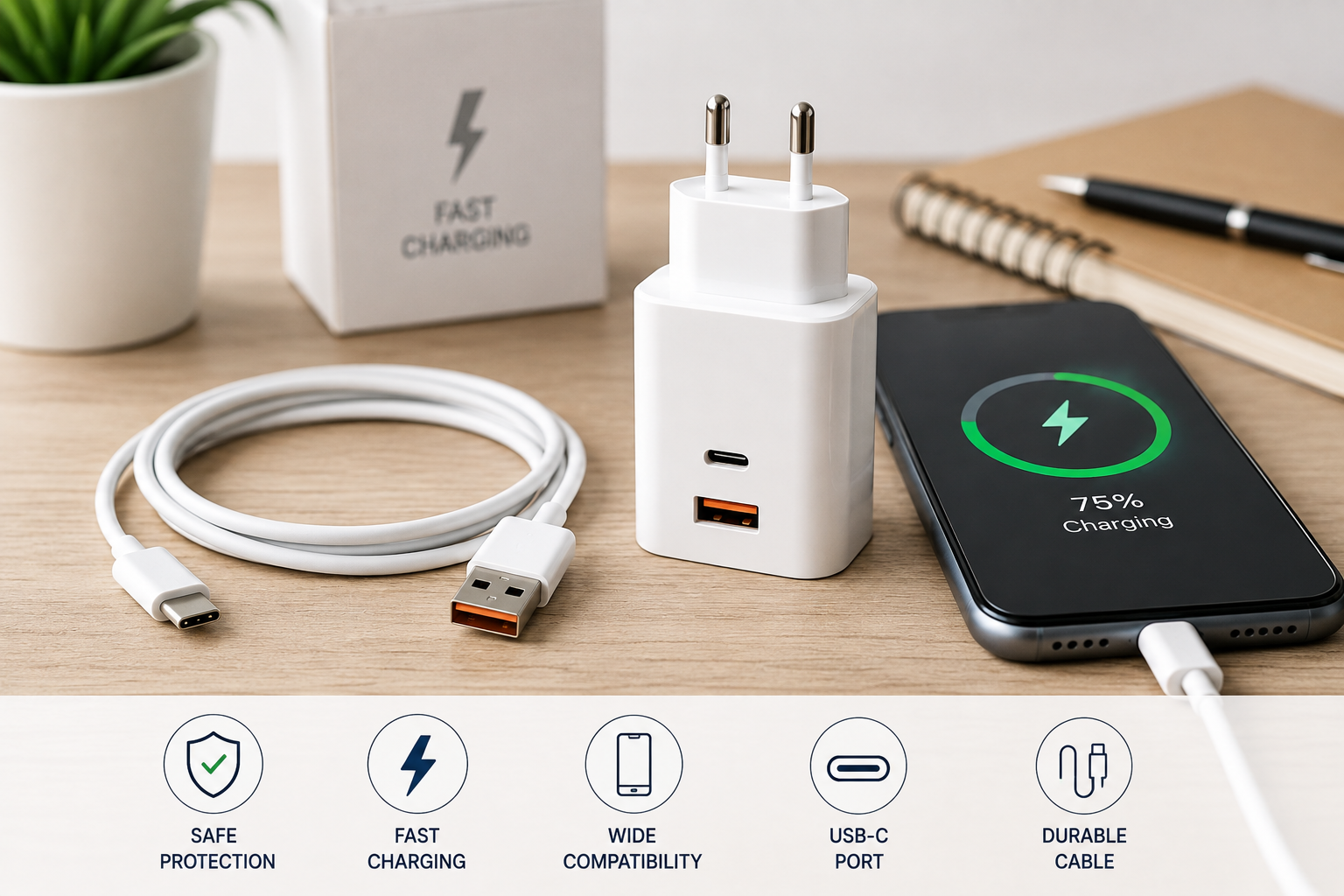
1. Check Your Device’s Supported Charging Speed
The first thing to check is how much charging power your device supports. This is usually measured in watts (W).
For example, one phone may support charging at up to 18W, while another may support 33W, 45W, or even higher. Buying a 100W charger for a phone that only accepts 25W will not necessarily make it charge at 100W.
The charger and phone communicate to determine how much power can be safely used. Your phone will normally take only the power it supports when using compatible equipment.
Before buying, check:
- Your phone’s maximum supported charging wattage
- Whether the manufacturer provides charging specifications
- Whether fast charging requires a specific charging standard
Knowing this information helps you avoid paying extra for power your device cannot use.
2. Choose a Compatible Charging Standard
Wattage alone does not tell you everything. Your phone may require a particular charging standard to achieve its fastest supported charging speed.
Common technologies include:
- USB Power Delivery (USB-PD)
- Qualcomm Quick Charge
- Manufacturer-specific fast-charging technologies
A charger may have enough wattage but still fail to provide the fastest charging speed if it does not support the charging method used by your device.
For example, two chargers may both be rated at 30W, but their compatibility with different phones can vary.
The best approach is to check your device’s specifications and choose a charger that supports the appropriate standard.
3. Check the Charger Port Type
Modern chargers are available with different output ports. The most common are:
- USB-C
- USB-A
USB-C has become increasingly common because it supports modern charging technologies and can handle higher power levels depending on the charger and cable.
However, you should not choose a charger based only on what looks newer. Check the cable you already use and the port on your device.
For example:
- A USB-C charger may require a USB-C to USB-C cable.
- A USB-A charger may work with an older USB-A charging cable.
- Some chargers include both USB-C and USB-A ports for greater flexibility.
If you are buying both a charger and cable, choosing compatible USB-C equipment can be a practical option for many modern devices.
4. Don’t Ignore the Charging Cable
Many people carefully choose a charger but forget that the cable also affects charging performance.
A poor-quality or incompatible cable may not support the power required for fast charging. It can also cause unreliable charging or wear out quickly.
Before buying a cable, check:
- The connector type at both ends
- Its supported charging capacity
- Whether it supports the fast-charging technology you need
- Its build quality and durability
If your phone supports fast charging but charges slowly, the cable could be one of the reasons.
A good charger and a suitable cable should work together.
5. More Watts Does Not Always Mean Better
It is easy to assume that the charger with the highest wattage is automatically the best choice. In reality, this is not always true.
If your device supports a maximum of 25W, buying a much more powerful charger may not make your phone charge faster. Your device is limited by its own supported charging capability.
However, a higher-watt charger can still be useful if you want to charge multiple devices or use the same charger for a phone, tablet, or other compatible device.
The important question is not simply:
“What is the most powerful charger?”
Instead, ask:
“What charger provides the right amount of power for my device and future needs?”
This can help you choose a charger that offers good value without paying for unnecessary features.
6. Consider Whether You Need Multiple Ports
A single-port charger may be enough if you only charge one phone. But a multi-port charger can be useful if you regularly charge several devices.
For example, you might want to charge:
- A smartphone
- Wireless earbuds
- A smartwatch
- A tablet
However, check how the charger’s total power is shared between its ports. A charger advertised with high total wattage may distribute that power differently when multiple devices are connected.
For example, the charging speed available to one device can change when another device is plugged in.
Always check the charger’s specifications if you plan to use multiple ports at the same time.
7. Choose Safety and Quality Over the Cheapest Option
A mobile charger handles electrical power every time you charge your device, so quality matters.
Very cheap, poorly made chargers may have unreliable components and may not provide consistent power. A charger from a reputable manufacturer is generally a better choice than an unknown product with unrealistic specifications.
Look for chargers that provide appropriate safety protections, such as protection against:
- Over heating
- Over current
- Over voltage
- Short circuits
You should also avoid products that make unrealistic claims, such as extremely high charging speeds without clearly explaining their specifications.
Reading reliable reviews and checking the actual technical details can help you make a better decision.
8. Think About Where and How You Will Use It
The best charger for home may not be the best charger for travel or everyday carrying.
If you also carry a power bank when traveling, our guide to choosing between 10,000mAh and 20,000mAh explains how capacity affects portability and charging needs.
If you mostly charge your phone beside your bed, a compact single-port charger may be enough. If you travel frequently, you may prefer a smaller charger that can handle more than one device.
Consider:
- Size and portability
- Number of ports
- Cable length
- Charging speed
- Compatibility with your other devices
A charger that fits your actual daily needs is usually a better choice than one with features you will never use.
Common Mistakes to Avoid When Buying a Mobile Charger
Before making your final choice, avoid these common mistakes:
Buying Based Only on Price
The cheapest charger may not offer the best quality, reliability, or compatibility. Consider value rather than price alone.
Buying the Highest Wattage Without Checking Your Phone
Your phone may not be able to use all that extra power. Check its supported charging speed first.
Forgetting About the Cable
Even an excellent charger may not deliver the expected charging speed with the wrong cable.
Assuming Every Fast Charger Works the Same Way
Different devices and chargers can use different charging standards. Compatibility matters.
Ignoring Multi-Port Power Sharing
If you plan to charge several devices, check how the charger distributes power between its ports.
How to Make the Right Choice
The right mobile charger does not have to be the most expensive or the most powerful one. It should simply match your device’s charging requirements and suit the way you use your devices.
Start by checking your phone’s supported charging speed and charging technology. Then choose a compatible charger, use a suitable cable, and consider whether you need extra ports or portability.
By focusing on compatibility, charging standards, wattage, cable quality, and safety, you can choose a charger that charges your device efficiently without wasting money on unnecessary features.
A little checking before you buy can help you find a charger that is faster, safer, and better suited to your device.
Pingback: How to Choose the Right USB-C Cable: 7 Things to Check