
Bluetooth speakers range from tiny shower-friendly pucks to backyard party units loud enough to fill a whole block — and the specs that matter change depending on which one you actually need. Picking based on price or brand name alone often means ending up with a speaker that’s either too weak for your space or overkill for how you’ll actually use it. Here’s exactly what to check before buying.
How Do You Know What Kind of Bluetooth Speaker You Need?
Before comparing models, think about how you’ll actually use it:
- Solo/personal listening (desk, shower, small room) — prioritize compact size and decent battery over max volume
- Outdoor/backyard use — prioritize loudness, battery life, and water/dust resistance
- Parties or group gatherings — prioritize volume, bass output, and possibly speaker pairing for stereo sound
- Travel — prioritize size, weight, and durability over raw power
Matching the speaker type to your actual use case matters more than chasing the highest wattage number.
What Types of Bluetooth Speakers Are There?
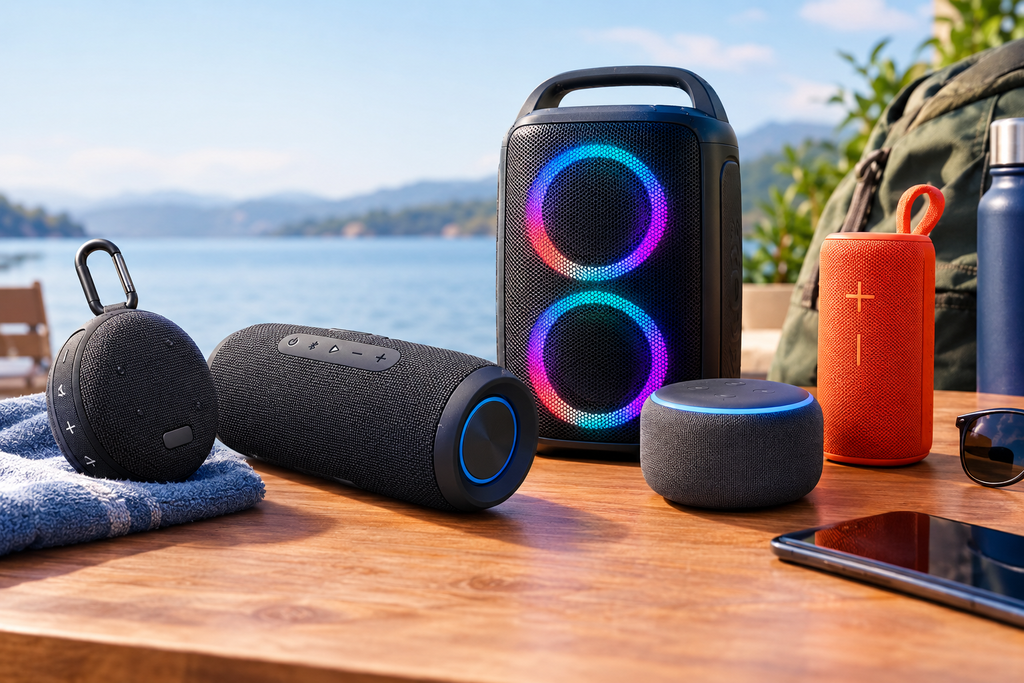
Portable/Personal Speakers
Small, lightweight, often fits in a bag or cup holder. Built for one-person or small-group listening on the move.
The SOW O Magnetic Portable Speaker is a great example — compact, clips onto gear, and rated IP67 with 24 hours of playtime.
Waterproof/Outdoor Speakers
Rated for rain, pool splashes, or dust exposure — ideal for beach trips, hiking, or poolside use.
The DUDGSIS Portable Bluetooth Speaker (IPX7 Waterproof) is a great example — fully waterproof with 20W sound and a 15-hour battery.
Party Speakers
Larger, heavier units with significantly more volume and bass, often with LED lights and long battery life for extended outdoor use.
The CHIFENCHY PulseSound Speaker is a good example, with beat-synced RGB lights and all-day playtime for a party atmosphere.
Smart Speakers (Voice Assistant Built-In)
Combine Bluetooth/Wi-Fi audio with Alexa or Google Assistant support — useful if you want voice control alongside music playback.
What Features Actually Matter When Choosing a Bluetooth Speaker?
1. How Loud Do You Actually Need It to Be?
Speaker output is usually listed in watts (W), but real-world loudness depends more on driver quality than the number alone. As a rough guide:
| Wattage | Best For |
|---|---|
| Under 10W | Personal/desk use, small rooms |
| 10–20W | Small gatherings, patios, kitchens |
| 20–50W | Backyard parties, larger outdoor spaces |
| 50W+ | Big parties, outdoor events |
2. How Long Does the Battery Last?
Battery life ranges from around 4 hours on tiny compact speakers to 20+ hours on larger party speakers. If you’re using it for all-day outdoor events, look specifically for 12+ hour ratings — real-world playback at higher volumes often falls short of the advertised number.
The BolaButty Bluetooth Speaker is a good example, rated for up to 24 hours of playtime on a single charge.
3. How Water and Dust Resistant Is It?
Check the IP (Ingress Protection) rating:
- IPX4 — splash resistant, fine for light rain or sweat
- IPX7 — can be fully submerged briefly, good for pool/beach use
- IP67 — dust-tight and waterproof, the most rugged rating you’ll commonly see
If you’re buying for outdoor or poolside use, don’t settle for anything below IPX5.
4. What Connectivity Options Should You Look For?
- Bluetooth version — 5.0 or higher gives better range and more stable connection
- Aux/3.5mm input — useful as a backup if Bluetooth isn’t available
- Speaker pairing — many brands let you pair two identical speakers for stereo sound or link many units together for bigger parties
- USB-C charging — more universal and faster than older micro-USB ports
5. How Important Is Sound Quality vs. Bass?
Bass-heavy “party” tuning sounds impressive at first listen but can muddy vocals and detail on quieter tracks. If you care about balanced sound (podcasts, acoustic music, vocals), look for speakers marketed around clarity rather than pure bass output. If you mostly play electronic, hip-hop, or dance music, a bass-forward speaker will likely suit you better.
The SOW O Q18 Bluetooth Speaker is a good example, delivering 25W of clear stereo sound with enhanced bass and no distortion.
How Much Should You Spend on a Bluetooth Speaker?
Budget ($20–$50)
Covers basic portable speakers with decent sound for personal use — fine for a desk, shower, or small room, but don’t expect much bass or outdoor volume.
A good example in this tier is this Portable Waterproof Bluetooth Speaker, offering IPX5 waterproofing and up to 24 hours of playtime at an affordable price.
Mid-Range ($50–$150)
This tier covers most buyers well — solid battery life, real waterproofing, better drivers, and enough volume for small-to-medium gatherings.
Our pick here is the Ortizan X10 Portable Bluetooth Speaker, offering IPX7 waterproofing, deep bass, and up to 30 hours of playtime.
Premium ($150+)
Includes serious party speakers with big bass output, extended battery life, and rugged builds, or premium-audio-focused speakers with noticeably better clarity and detail.
For a top-tier option, consider the JBL Grip Portable Speaker, featuring bold JBL Pro Sound, AI Sound Boost, and IP68 waterproof/dust-proof protection.
How Do You Make a Bluetooth Speaker Last Longer?
- Avoid charging it to 100% and leaving it plugged in constantly — partial charges extend battery lifespan
- Rinse off sand, dust, or chlorine residue after outdoor/poolside use, even on waterproof models
- Store it somewhere dry between uses rather than leaving it outside
- Avoid maxing out volume for extended periods, which stresses the drivers over time
- Keep the firmware updated if the manufacturer offers a companion app
The TREBLAB CB-77 Carrying Case fits most portable speakers and adds a layer of everyday protection.
So, How Do You Choose the Right Bluetooth Speaker for You?
Start with how and where you’ll actually use it — personal listening calls for something small and efficient, while outdoor gatherings call for volume, battery life, and real water resistance. From there, a mid-range speaker from a known brand will cover most people’s needs without overpaying for party-scale power you won’t use.
If portable audio is becoming a bigger part of your setup, it’s worth also checking our wireless earbuds buying guide for on-the-go listening, or comparing options in our smartwatch buying guide if you’re building out your everyday tech.
Disclosure: As an Amazon Associate, we earn from qualifying purchases made through links on this page.