
Buying a new phone every time a newer model comes out isn’t always a smart decision. If your current phone still performs well, replacing it may simply mean spending money without solving a real problem.
But keeping an old phone for too long can also become frustrating when performance, battery life, storage, software support, or reliability starts getting in the way.
So how do you know when it’s actually time to upgrade?
Instead of judging your phone only by its age, look at how it performs in your everyday life. Here are seven signs that can help you decide whether your current phone is still worth keeping.
How Do You Know When Your Phone Is Too Old?
There is no universal age at which a phone suddenly becomes too old.
One person may be perfectly happy using a phone for four or five years, while another may need to replace one much sooner because of their workload or requirements.
The better question is:
Is your current phone still doing everything you need it to do?
If the answer is yes, age alone isn’t a good reason to replace it.
If the answer is no, identify exactly what is causing the problem before buying a new device.
Why Is My Phone Getting Slow?
A phone becoming noticeably slower is one of the clearest signs that an upgrade might eventually be necessary.
If opening apps, switching between applications, browsing the web, or performing simple tasks has become frustrating, your phone may be struggling with newer software and applications.
However, don’t immediately assume that you need a new phone.
First, try:
- Removing applications you no longer use
- Freeing up unnecessary storage
- Restarting the phone
- Installing available software updates
- Checking which applications are consuming the most resources
If the phone remains consistently slow after basic maintenance, its hardware may no longer be sufficient for your current needs.
How Long Should a Phone Battery Last?
Battery life is another reason people eventually replace their phones.
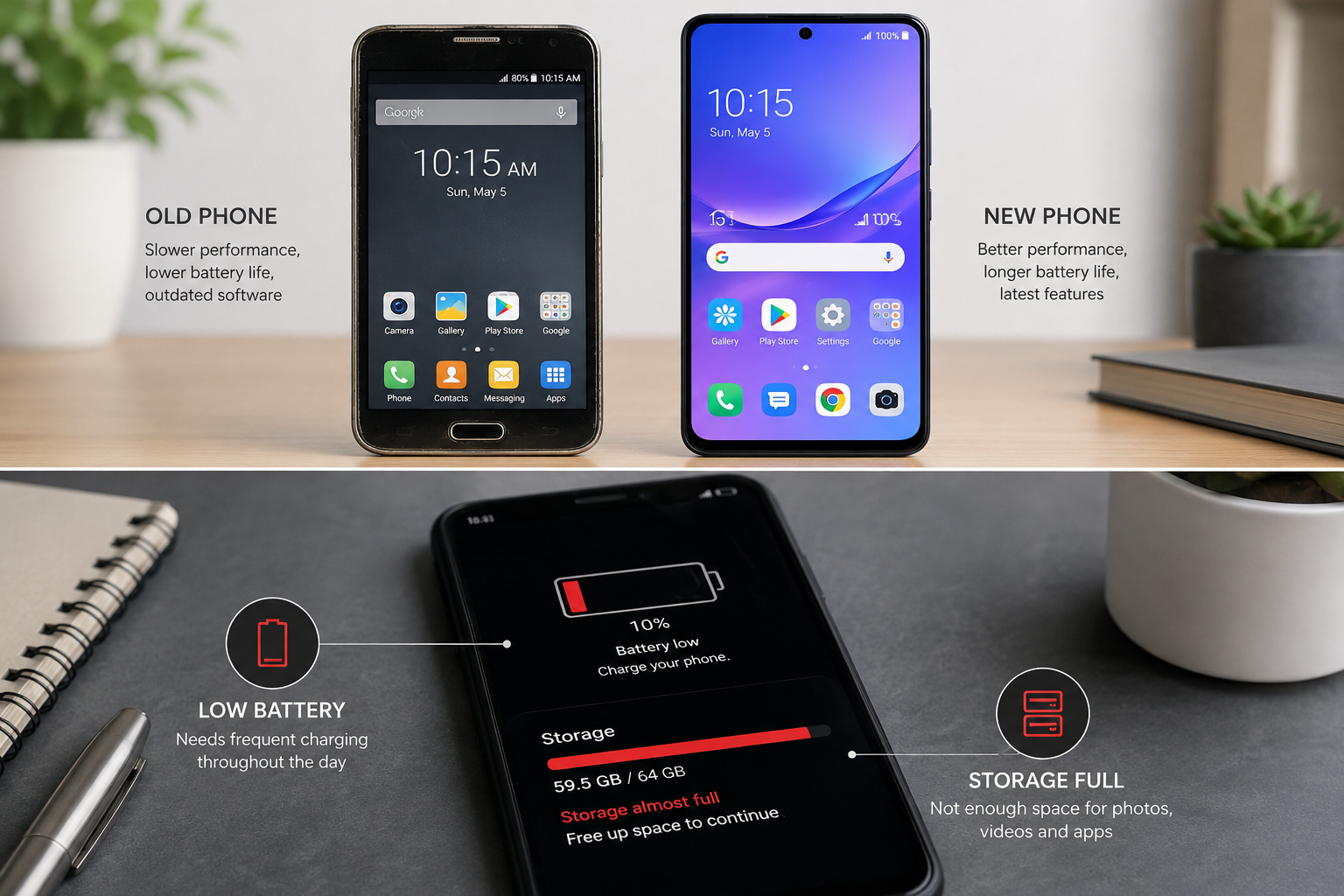
A phone that comfortably lasted an entire day when you first bought it may eventually require charging much more frequently.
Ask yourself:
- Does the battery last through your normal day?
- Do you regularly need a charger or power bank?
- Does the battery percentage drop unusually quickly?
- Has charging become a daily inconvenience?
If battery life has become a serious problem, you don’t necessarily need a new phone immediately. A battery replacement may be considerably cheaper if the rest of the device is still working well.
Does My Phone Need an Upgrade Because of Software Updates?
Software support is an important part of a phone’s useful life.
Regular Android updates can include security fixes, bug fixes, performance improvements and compatibility improvements
As a phone gets older, it may eventually receive fewer operating-system updates or security updates. Eventually, some applications may also stop supporting the version of the operating system installed on your device.
That doesn’t mean every older phone suddenly becomes unsafe or unusable.
Instead, check the manufacturer’s support policy for your particular model and consider how important continued updates are for the way you use your phone.
You can also check your phone’s available security and Google Play system updates from its settings.
If your phone is no longer receiving important updates and you plan to keep it for several more years, upgrading may make more sense.
Is Low Phone Storage a Reason to Buy a New Phone?
Constantly running out of storage can make an otherwise good phone frustrating to use.
If you regularly have to delete photos, videos, applications, or documents just to make room for new files, your storage capacity may no longer suit your needs.
My own experience with the Infinix Zero 30 has shown me how useful having enough storage can be.
I bought the 256GB version, and after more than two years of use, storage has not been a major problem for me. I have been able to keep my files and applications without constantly worrying about running out of space.
This is one reason I think storage should be considered carefully when buying a phone.
If you take lots of videos, keep a large photo library, download large files, or use many applications, insufficient storage can eventually become a genuine reason to upgrade.
Should You Upgrade Your Phone Just for a Better Camera?
Not necessarily.
A newer phone may have a better camera, but that doesn’t automatically mean replacing your current phone is worth the money.
First ask yourself how important photography actually is to you.
If you mainly take occasional photos for messaging or social media, an older camera that produces acceptable results may be perfectly adequate.
My Infinix Zero 30 is a good example. Its camera specifications look impressive on paper, but based on my actual experience, I would describe the camera results as medium or acceptable rather than exceptional.
The camera has been sufficient for my everyday needs, but if photography were my highest priority, I would look for a phone with stronger camera performance.
Can Network Problems Mean You Need a New Phone?
Sometimes connectivity problems can make people think their phone needs replacing.
Dropped calls, unclear voice quality, unreliable mobile data, Wi-Fi problems, or Bluetooth issues can certainly make a phone frustrating.
But don’t immediately assume the phone is responsible.
Network coverage, the SIM card, your carrier, local conditions, and even the network itself can affect call and data performance.
I’ve occasionally experienced dropped calls and unclear voice quality with my Infinix Zero 30. However, I have noticed similar problems with other phones, so I cannot confidently say that the phone itself is responsible.
Before buying another phone, test the SIM in another device if possible. If the same problem continues, the phone may not be the real cause.
When Is Repairing an Old Phone Better Than Replacing It?
Sometimes the right decision isn’t buying a new phone—it’s repairing the one you already have.
For example, replacing a worn battery can make sense if the phone still performs well in every other area.
But if the device needs several expensive repairs at once, the calculation changes.
Before spending money on repairs, compare:
- Repair cost
- Current condition of the phone
- Expected remaining lifespan
- Cost of a suitable replacement
- Importance of the problem you’re trying to fix
A relatively inexpensive repair can extend the useful life of a good phone. An expensive repair on a severely outdated device may not be worth it.
When Should You Keep Your Old Phone Instead of Upgrading?
Keeping your current phone can actually be the better financial decision if it still meets your needs.
Consider keeping it if:
- It remains responsive
- Battery life is acceptable
- You have enough storage
- Your apps work properly
- It receives appropriate software support
- The camera is good enough for your needs
- There are no major hardware problems
A phone doesn’t become bad simply because newer models are available.
What Has My Infinix Zero 30 Experience Taught Me?
I bought my Infinix Zero 30 on May 5, 2024, and I’ve been using it since then.
My overall experience with the Infinix Zero 30 has remained good, and I have covered my long-term experience in more detail in my Infinix Zero 30 review after 2+ years.
The phone has not experienced significant hanging in my normal use, and the 256GB storage has been particularly useful. I also haven’t experienced problematic heating during normal use.
Battery life has been satisfactory for me. After a full charge, I generally get around 5 to 6 hours of use, depending on what I’m doing.
The camera is one area where I would describe the experience as average rather than exceptional.
I’ve also experienced occasional dropped calls and unclear voice quality, but because similar network problems have occurred with other phones, I don’t think it would be fair to blame the phone without stronger evidence.
This experience has changed how I think about upgrading.
A phone’s age is only one part of the decision.
What matters more is whether it still performs the tasks you actually need.
What Should You Check Before Buying a New Phone?
Before spending money on a replacement, make a simple list of the problems you’re trying to solve.
Problem: Phone is slow
Possible solution: Upgrade if maintenance doesn’t help.
Problem: Battery doesn’t last
Possible solution: Consider a battery replacement before replacing the phone.
Problem: Storage is always full
Possible solution: Free up space or consider a higher-storage phone.
Problem: Camera isn’t good enough
Possible solution: Upgrade if photography is genuinely important to you.
Problem: Calls keep dropping
Possible solution: Check the SIM and network before blaming the phone.
Is It Really Worth Upgrading Your Phone?
The best reason to upgrade is not that your phone is old.
It’s that your current phone no longer meets your needs.
If it’s slow, unreliable, constantly running out of storage, struggling with battery life, losing software support, or failing to provide the features you genuinely need, an upgrade may be worthwhile.
But if your phone still handles your everyday tasks comfortably, keeping it for another year—or even longer—may be the smarter choice.
Before you buy a new phone, ask yourself one question:
What specific problem am I trying to solve by replacing my current phone?
If you can answer that clearly, you’re much more likely to spend your money on an upgrade that actually improves your everyday experience.
Pingback: 10,000mAh vs 20,000mAh Power Bank: Which Should You Buy?
Pingback: RAM vs Storage: What’s the Difference and Which Matters More?
Pingback: How to Choose the Right Smartwatch (2026 Buying Guide)