
When buying a smartphone, RAM is one of the specifications you’ll see everywhere. A phone may have 6GB, 8GB, 12GB or even 16GB of RAM, and it is easy to assume that more RAM automatically means a better and faster phone.
It doesn’t quite work that way.
RAM affects how well your phone handles apps, multitasking and background processes, but it is only one part of the overall performance. The processor, software optimization, storage technology and the way you use your phone also matter.
So how much RAM do you actually need?
For most people, 8GB of RAM is a sensible amount for a modern smartphone. 6GB can still be enough for lighter everyday use, while 12GB or more makes more sense for heavy multitasking, demanding games or people who want extra headroom for future use.
What Does RAM Do in a Phone?
RAM stands for Random Access Memory.
Think of RAM as your phone’s short-term working space. When you open an app, the phone uses RAM to keep the information that the app needs readily available.
For example, you might:
- Open Chrome
- Switch to WhatsApp
- Check Instagram
- Open YouTube
- Return to Chrome
If enough RAM is available, your phone can keep more of those apps ready in the background. If RAM becomes limited, the system may remove some apps from memory and reload them when you return.
This is why RAM is particularly important for multitasking.
However, RAM isn’t the same as your phone’s storage.
Is Phone RAM the Same as Storage?
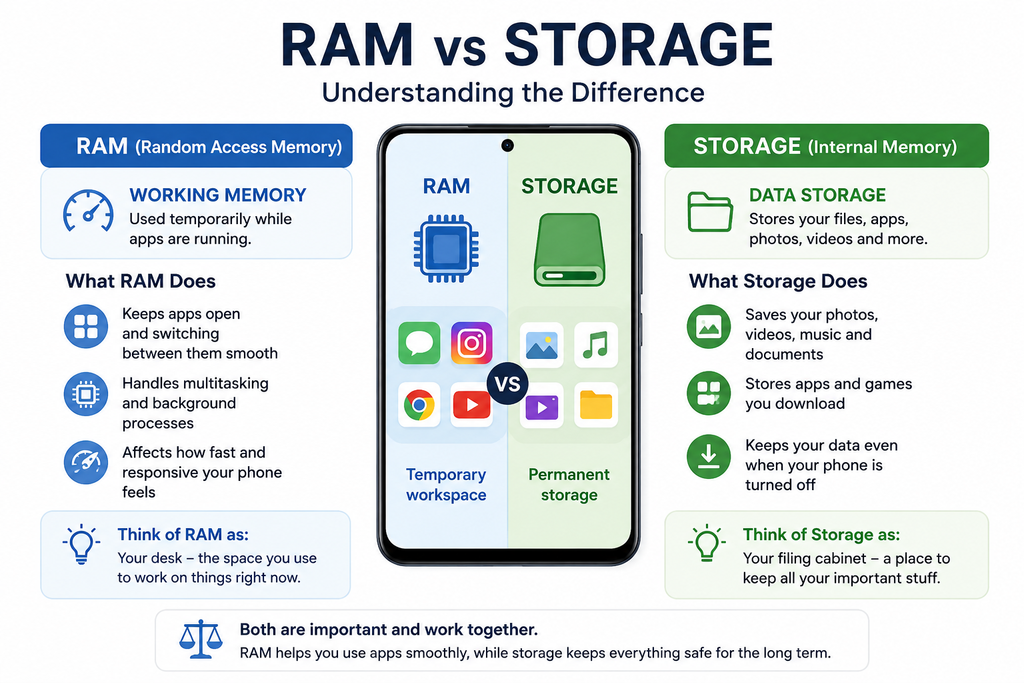
No. RAM and storage perform completely different jobs.
Your phone’s storage is where your photos, videos, apps, documents and other files remain saved.
RAM is temporary working memory used while the phone is running.
A simple way to understand it is:
Storage = where your files live
RAM = workspace used while you’re doing things
For example, a phone with 256GB storage and 8GB RAM has plenty of space for storing files, but the 8GB RAM determines how much working memory is available for running apps and multitasking.
If you’re interested in a real-world example of how storage and RAM can work together, you can also read our Infinix Zero 30 review.
Having more storage does not automatically give you more RAM.
How Much RAM Does a Phone Need?
There isn’t one perfect RAM amount for everyone.
Your ideal amount depends on what you actually do with your phone.
Is 6GB RAM Enough for a Phone?
6GB can be enough for light to moderate everyday use.
It can handle activities such as:
- Messaging
- Web browsing
- Social media
- Music streaming
- Watching videos
- Normal everyday apps
However, phones with 6GB may need to reload apps more frequently when you switch between many demanding applications.
If you’re buying a phone today and expect to keep it for several years, I’d generally prefer 8GB over 6GB when the price difference is reasonable.
Is 8GB RAM Enough for a Phone?
8GB is the sweet spot for many smartphone users.
It provides enough working memory for normal multitasking without paying extra simply for a larger specification.
For someone who regularly uses:
- Social media
- Web browsers
- Messaging apps
- Streaming services
- Photography
- Navigation
- Shopping apps
- Productivity apps
8GB is generally a comfortable choice.
It’s also a good middle ground if you don’t want to replace your phone frequently.
Is 12GB RAM Better Than 8GB?
12GB makes more sense for heavier users.
You may benefit from 12GB if you:
- Frequently switch between many apps
- Play demanding games
- Edit photos or videos
- Use resource-heavy applications
- Keep your phone for several years
- Want additional memory headroom
But don’t assume a 12GB phone will automatically feel 50% faster than an otherwise similar 8GB phone.
If your normal usage doesn’t require the additional memory, you may notice little practical difference.
Do You Need 16GB RAM in a Phone?
For most smartphone users, 16GB is more than necessary.
It can make sense for particularly demanding workloads or high-end gaming phones, but ordinary users generally shouldn’t buy a phone simply because the box says 16GB.
If you’re choosing between a well-designed 8GB phone and a mediocre 16GB phone, RAM alone shouldn’t determine your decision.
Is 8GB RAM Enough for Gaming?
For most mobile gamers, 8GB is a reasonable starting point.
But gaming performance depends on much more than RAM.
The processor and GPU are extremely important because they perform the actual game calculations and graphics work. Cooling, display resolution, software optimization and the game’s own requirements can also affect performance.
A phone with 12GB RAM but a weaker processor isn’t automatically better for gaming than an 8GB phone with a significantly more capable processor.
So if gaming is important to you, look at the whole hardware package, not just the RAM number.
Is 12GB RAM Better Than 8GB?
Technically, 12GB gives you more memory headroom than 8GB.
But whether you will actually benefit from it depends on your usage.
If you mostly browse the web, use messaging apps, watch videos and use social media, 8GB may already provide enough memory.
If you regularly perform demanding tasks or switch between many heavy applications, the additional RAM can be useful.
The important question isn’t:
“Which phone has more RAM?”
It’s:
“Will I actually use the additional RAM?”
That’s a much better way to make the decision.
Does More RAM Make a Phone Faster?
Not necessarily.
More RAM can help when your phone is running out of working memory, particularly during multitasking.
But if your phone already has enough RAM for your normal usage, adding more won’t automatically make everything faster.
Other components have a major influence on speed, including:
- Processor
- GPU
- Storage technology
- Software optimization
- App optimization
- Thermal management
This is why you shouldn’t compare smartphones using RAM alone.
A well-optimized phone with 8GB RAM can feel faster and smoother than a poorly optimized phone with more RAM.
Does RAM Affect Battery Life?
RAM can have an effect on power consumption, but more RAM doesn’t simply mean better or worse battery life.
A phone’s battery performance depends on many factors, including:
- Screen size and brightness
- Processor efficiency
- Network connection
- Background applications
- Software optimization
- Battery capacity
- Refresh rate
- How heavily you use the phone
Keeping more applications in memory can be useful because apps may not need to reload as often, but the relationship between RAM and battery life is not simple enough to say that “more RAM equals longer battery life.”
What Happens When a Phone Runs Out of RAM?
Modern smartphones manage RAM automatically.
When available RAM becomes limited, the operating system can manage background processes and may remove inactive apps from memory.
You might notice this when an app reloads instead of returning exactly where you left it.
For example, you could be writing something in a browser, switch to another demanding application and then return to the browser. If the browser was removed from memory, it may have to reload the page.
This doesn’t necessarily mean your phone is defective.
It can simply mean that the operating system needed to manage limited memory.
Does More RAM Keep Apps Open in the Background?
It can help, but it isn’t the only factor.
A phone with more available RAM has more room to keep apps in memory. However, the operating system decides how memory should be managed.
Two phones with the same RAM capacity can behave differently because of differences in:
- Operating system
- Manufacturer software
- Memory management
- App optimization
- Background restrictions
So don’t assume that a 12GB phone will always keep twice as many apps open as a 6GB phone.
What Is Virtual RAM on a Phone?
Some smartphone manufacturers advertise features such as virtual RAM, RAM expansion or memory extension.
These features typically use a portion of the phone’s internal storage to help manage memory when needed.
It can be useful in certain situations, but it should not be treated as equivalent to having the same amount of physical RAM.
For example, a phone advertised as having “8GB + 8GB extended RAM” should not automatically be considered the same as a phone with 16GB of physical RAM.
When comparing phones, pay attention to the actual physical RAM first.
Should You Buy More RAM for Future-Proofing?
This is where buying slightly more RAM can make sense.
If you’re planning to keep a phone for several years, choosing 8GB instead of 6GB, or 12GB instead of 8GB when the price difference is small, may give you additional headroom as apps and operating systems become more demanding.
If you’re wondering whether your current phone is still worth keeping, see our guide to 7 signs it’s time to upgrade your phone.
But there’s no guarantee that more RAM alone will make a phone last longer.
Battery health, software support, processor performance, storage capacity and overall build quality also affect how useful a phone remains over time.
So consider RAM as one part of future-proofing, not the entire strategy.
Does Storage Speed Matter More Than RAM?
For some everyday tasks, fast storage can make a noticeable difference.
Modern smartphones increasingly use fast flash storage technologies, and faster storage can contribute to quicker app loading, file transfers and system responsiveness.
This doesn’t mean storage speed is “more important” than RAM in every situation.
They solve different problems.
RAM helps with active multitasking and working memory.
Storage holds your data and contributes to loading and transfer performance.
A good smartphone needs an appropriate balance of both.
How Much RAM Do You Need for Social Media and Everyday Apps?
If your main activities are:
- WhatsApp or other messaging apps
- TikTok
- YouTube
- Web browsing
- Music
- Online shopping
You don’t need an extreme amount of RAM.
6GB can handle basic use, while 8GB is the more comfortable choice for most people.
I’d choose 8GB if you’re buying a new phone and intend to use it for several years.
How Much RAM Do You Need for Heavy Multitasking?
If you frequently jump between demanding applications and want more apps to remain ready in the background, 12GB can be worthwhile.
This is particularly relevant if your phone is also your primary productivity device.
However, don’t buy 12GB solely because you occasionally open several apps. Consider whether your current phone actually struggles with multitasking.
If your existing 8GB phone works smoothly for everything you do, there may be little reason to pay significantly more for 12GB.
Should You Choose More RAM or a Better Processor?
If you’re forced to choose between more RAM and a significantly better processor, don’t automatically choose the RAM.
For example, an 8GB phone with a modern, capable processor may provide a better overall experience than a 12GB phone with a much weaker processor.
The processor affects:
- App performance
- Gaming
- Image processing
- Video processing
- System responsiveness
- Power efficiency
RAM is important, but it works alongside the processor rather than replacing it.
How Much RAM Should You Look for When Buying a Phone?
Here’s the simple way to approach it:
6GB: Suitable for lighter everyday use, especially if the phone is well optimized.
8GB: The best balance for most people and the amount I’d recommend starting with when buying a modern phone.
12GB: Worth considering for heavy multitasking, demanding gaming and long-term use when the price difference is reasonable.
16GB+: Mainly for specific high-end use cases; unnecessary for most buyers.
The Bottom Line
Don’t choose a smartphone simply because it has the highest RAM number.
If you use your phone mainly for messaging, browsing, social media, streaming and everyday applications, 8GB is generally enough.
If you are a heavier user who games extensively, multitasks aggressively or wants additional headroom for long-term use, 12GB can be a sensible upgrade.
And if you’re looking at a phone with 16GB or more, ask yourself whether your actual usage requires it before paying extra.
The best phone isn’t the one with the most RAM. It’s the one whose RAM, processor, storage, software and battery all match the way you actually use it.